
Printing Business Software Case Study: How We Helped Kings Printer to Achieve Multi-State Expansion Through Digital Transformation
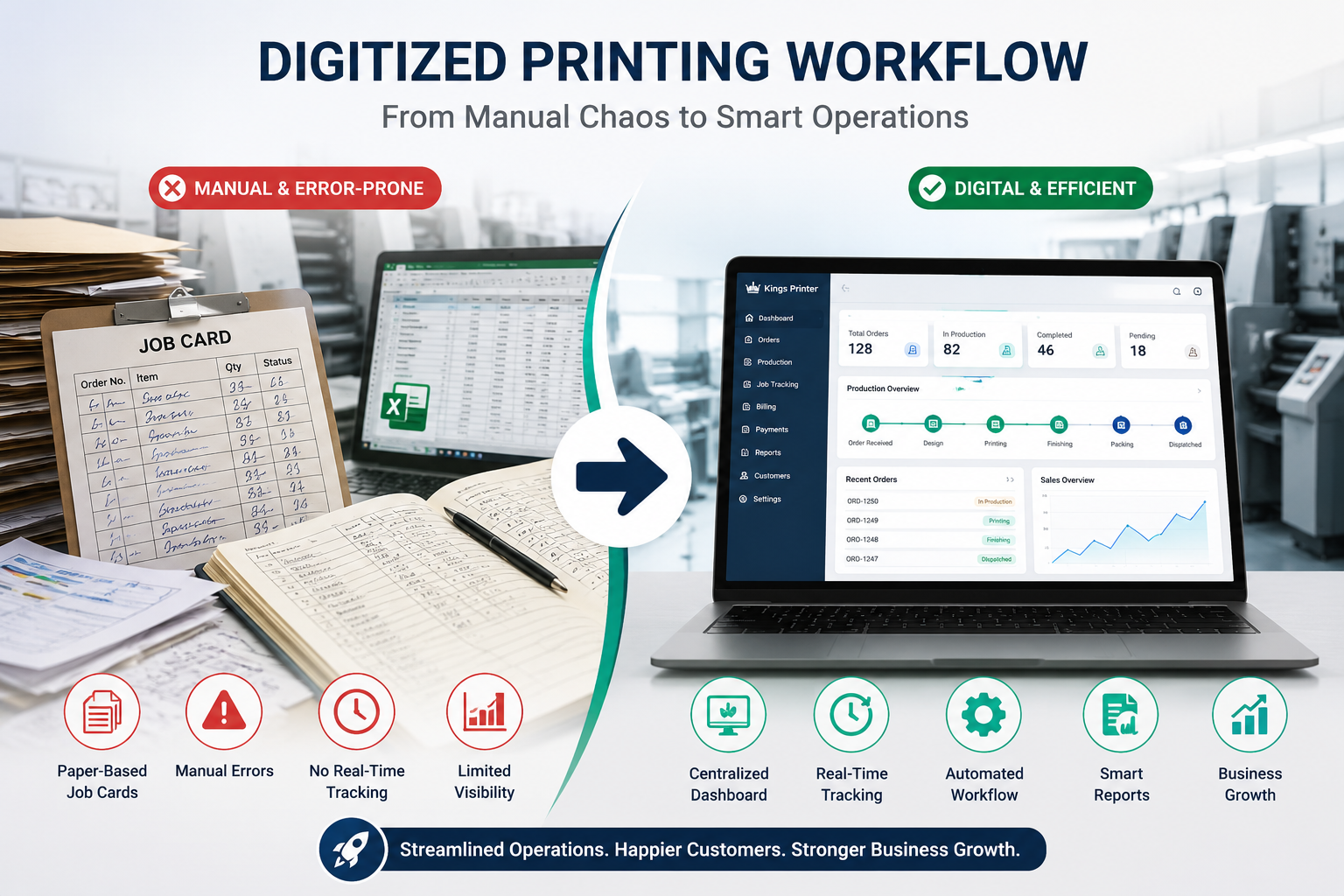
From Paper Registers to Real-Time Production Tracking: Reducing Manual Errors in a Printing Business Through Custom Software
Every industry eventually reaches a fork in the road: keep doing things the way they've always been done, or invest in systems that can carry the business further than manual effort ever could.
For Kings Printer, a well-established printing house in Jaipur, that fork arrived after 15 years of steady, reputation-built growth — and the choice they made changed the shape of their business entirely.
This case study walks through how a legacy, paper-driven printing operation was transformed into a digitally managed, multi-state enterprise through custom software development — and why the right technology partner, not just the right technology, made all the difference.
Client Background
Kings Printer is a Jaipur-based printing company with a 15-year track record in the trade. Over the years, the business built a loyal customer base around core print products — visiting cards, pamphlets, letterheads, and similar commercial printing items — each available in multiple variants such as size, paper quality, die-cut shapes, and single- or double-sided printing.
The company was led by Mr. Hitesh, a printing industry veteran who understood every operational nuance of running a press: raw material sourcing, machine scheduling, quality checks, and customer relationships. What he did not have — and had no obligation to have — was expertise in software systems, digital order management, or scalable business infrastructure.
The connection to our team came through a trusted referral chain. Ms. Richa Gupta, Vice President and Head of Operations at D & P Advisory, had worked with our team for more than a decade across various websites and e-commerce projects. Having repeatedly seen our ability to solve problems that other developers had been unable to crack, she referred us to a friend in Singapore, whose brother — Mr. Hitesh — was looking to expand Kings Printer beyond its home state. This is precisely how long-term trust compounds: one strong client relationship opening doors to new ones, built entirely on demonstrated capability rather than sales pitches.
The Challenge
Mr. Hitesh had a clear commercial ambition: expand Kings Printer's footprint across multiple cities and multiple states in India. He had even studied one competitor's portal already running in the market and wanted something comparable. But intent alone doesn't build infrastructure.
The core challenge was a knowledge gap, not a motivation gap. Mr. Hitesh and his team:
- Understood printing deeply but had no visibility into how an online portal manages orders on the backend
- Had no framework for how digital order processing, billing, or payments should work
- Did not know what kinds of reports a growing, multi-location business would eventually need
- Had never scoped a software project and had no internal language to communicate technical requirements
In short, this wasn't a case of a client asking for a specific feature set. It was a case of a business owner recognizing a growth ceiling without having the vocabulary to describe the system needed to break through it.
Why Existing Methods Were Failing
Before any development work began, our team visited the Kings Printer facility to observe operations firsthand. What we found was a business that had scaled its craftsmanship far beyond its administrative infrastructure.
The entire operation ran on a Job-Card system — a manual, paper-based method of tracking each order from intake to delivery — supported by Excel sheets for reporting. While this had worked adequately at a single-location scale, it carried structural weaknesses that would only compound as the business grew:
- Human error at every handoff. Each time an order changed hands — from sales to production to packing to dispatch — there was a chance for details to be miswritten, misread, or lost entirely.
- No real-time visibility. Nobody outside the physical premises could check an order's status. Management had no way to see production bottlenecks as they happened.
- Reporting was reactive, not proactive. Because reports were compiled manually in Excel after the fact, decision-makers were always looking backward rather than managing in real time.
- Zero scalability. A paper Job-Card system that just barely functions for one location becomes unmanageable across five or six states. Multiplying manual processes multiplies the error rate, not just the workload.
- No standardization across product variants. With multiple products, each having its own size, paper quality, die-cut, and print-side variants, manually tracking every permutation invited confusion and costly production mistakes.
This is a familiar pattern across traditional Indian manufacturing and service businesses: deep operational expertise paired with administrative systems that never evolved past their original scale. It's rarely a knowledge failure — it's an infrastructure failure.
Our Analysis
Our first instinct, honestly, was that this would be a demanding project — not because the technical requirements were unusually complex, but because our team and the client were, in a sense, speaking two different languages. Mr. Hitesh thought in terms of paper stock, die-cutting, and delivery timelines. We thought in terms of databases, workflows, and system architecture.
The turning point came when Mr. Hitesh introduced us to Mr. Jetindera, his brother-in-law, who was already running his own e-commerce portal. Because Mr. Jetindera had prior exposure to digital business systems, he could understand the logic, flowcharts, and process design our team proposed — and, critically, he could translate that understanding into terms the rest of the Kings Printer team could relate to.
From there, our analysis phase involved:
- Cataloguing every product line — visiting cards, pamphlets, letterheads, and other core offerings — along with every variant: size, paper quality, die-cut shape, and front/back/both printing options.
- Mapping the manual order journey — from the moment a customer placed an order, through production stages, to final packing and delivery.
- Identifying failure points in the existing Job-Card and Excel-based process.
- Running multiple rounds of Q&A sessions covering various real-world situations, locations, and permutations — essentially stress-testing the proposed system against scenarios the business was likely to encounter as it expanded.
This iterative, consultative process culminated in a finalized flowchart that both the client and our development team agreed represented the true operational reality of the business — not an idealized version of it.
Solution We Proposed
Rather than offering an off-the-shelf printing e-commerce template, we recommended a fully custom-built platform designed specifically around Kings Printer's product catalogue, variant complexity, and multi-stage production process.
The proposed solution centered on digitizing the entire order lifecycle:
- Digital order capture that accounted for every product variant combination
- A structured production workflow replacing the manual Job-Card system
- Centralized billing and payment tracking
- A reporting layer giving management real-time insight into orders, production status, and business performance
- An architecture built to support expansion into new cities and states without requiring a system redesign each time
The emphasis throughout was on future-proofing. Since Mr. Hitesh's stated goal was multi-city, multi-state expansion, the system had to be built with that scale in mind from day one — not retrofitted later once growing pains forced the issue.
Technology Used
The platform was developed as a custom software solution using a proven, stable technology stack:
- Backend Language: PHP 8.1
- Database: MySQL
- Frontend Interactivity: jQuery and AJAX for smooth, responsive user interactions without full page reloads
- Hosting Infrastructure: A self-managed dedicated server, chosen specifically to ensure fast, reliable, and smooth performance from launch onward
The development timeline reflected the care taken at each stage:
- Development phase: Approximately 2 months
- Testing and bug-fixing phase: 15 days
- Pre-launch: Deployment to a dedicated server environment ahead of go-live
Choosing a dedicated server rather than shared hosting was a deliberate decision. A printing business processing orders across multiple locations needed consistent uptime and performance — something shared hosting environments can't reliably guarantee once traffic and transaction volume increase.
Features Implemented
The final platform replaced the manual Job-Card system with a structured, digital equivalent that covered the full operational cycle:
- Product and variant management — supporting visiting cards, pamphlets, letterheads, and other items, each configurable by size, paper quality, die-cut shape, and print orientation.
- End-to-end order processing — from order placement through each production stage to packing and delivery.
- Billing and payment tracking — replacing manual invoicing with a centralized, digital record.
- Operational reporting — giving management the visibility that Excel-based reporting never could, since data was now captured at the source rather than reconstructed afterward.
- Multi-location readiness — a system architecture designed to accommodate new cities and states as the business expanded, without requiring core redevelopment.
Each of these features traced directly back to a specific weakness identified during the analysis phase — this wasn't a generic feature list, but a targeted response to Kings Printer's actual operational gaps.
Business Results
The results speak plainly to the value of getting the underlying system right before scaling.
More than two years after launch, Kings Printer has expanded from its home state of Rajasthan into more than five additional states, including Madhya Pradesh, Haryana, Punjab, Gujarat, and Delhi. What began as a single-location, paper-based operation is now a multi-state business running on a digital backbone built specifically for its way of working.
This kind of growth would have been extremely difficult — arguably impossible to manage cleanly — on the original Job-Card and Excel system. Manual processes that already strained under single-location volume simply cannot absorb the complexity of coordinating orders, production, and reporting across six states.
Lessons Learned
A few principles emerged clearly from this engagement, ones that apply well beyond the printing industry:
- Domain expertise and technology expertise are different skill sets — and that's fine. Mr. Hitesh didn't need to become a software expert. He needed a partner who could translate his operational knowledge into a working digital system.
- A trusted intermediary accelerates alignment. Mr. Jetindera's prior exposure to e-commerce systems helped bridge the communication gap between the client and our development team far faster than documentation alone could have.
- Understanding the "why" behind requests matters more than executing a feature list. By observing the physical operations and manually walking through the order journey first, we designed a system grounded in reality, not assumptions.
- Custom development pays off when standard workflows don't fit. A business with this many product variants and this specific a production process was unlikely to be served well by a generic template.
- Build for the destination, not just the starting point. Because the system was designed with multi-state expansion in mind from the outset, scaling later didn't require rebuilding the foundation.
How Similar Businesses Can Benefit
Kings Printer's story isn't unique to the printing industry. Countless manufacturing, wholesale, and service businesses across India — and globally — are running on the operational equivalent of paper Job-Cards: spreadsheets, physical registers, and informal tracking methods that worked fine at a smaller scale but quietly cap how far the business can grow.
If your business recognizes any of the following patterns, it may be facing the same fork in the road Kings Printer once did:
- Orders or jobs are tracked manually, with information re-entered at multiple stages
- Reporting happens after the fact, in Excel, rather than in real time
- There's no clear visibility into where a job or order currently stands
- Expansion plans exist, but there's uncertainty about how backend operations would actually scale
- Leadership has deep industry expertise but limited insight into digital operations
The path forward doesn't require becoming a technology company. It requires finding a development partner willing to do what we did with Kings Printer: visit the operation, understand the real workflow, ask the right questions repeatedly, and design a system around the business — not force the business to adapt to a generic template.
As this project reaffirmed for us: you need expert consultation and careful planning before development even begins. The strongest software isn't the one with the most features — it's the one built by people who took the time to understand exactly how your business actually works.
Frequently Asked Questions
1. What problem was Kings Printer facing before digitization?
Kings Printer was relying on a manual Job-Card system supported by Excel-based reporting, which was error-prone and difficult to scale as the business aimed to expand into new cities and states.
2. Why did the client choose custom software instead of an existing e-commerce platform?
Because Kings Printer had a complex catalogue of products with multiple variants — size, paper quality, die-cut shape, and print orientation — a custom-built solution allowed the system to match their exact production workflow rather than forcing the business into a generic template.
3. What technology stack was used to build the platform?
The platform was built using PHP 8.1 as the backend language, MySQL as the database, and jQuery/AJAX for responsive frontend interactions, hosted on a self-managed dedicated server.
4. How long did the project take to complete?
Development took approximately 2 months, followed by 15 days of testing and bug-fixing before the platform was launched.
5. What specific features were included in the final system?
The system included product and variant management, end-to-end order processing, billing and payment tracking, operational reporting, and an architecture built to support multi-location expansion.
6. How did the business results change after implementing the new system?
Within just over two years of launch, Kings Printer expanded from operating solely in Rajasthan to running operations across more than five additional states, including Madhya Pradesh, Haryana, Punjab, Gujarat, and Delhi.
7. Why was a dedicated server chosen over shared hosting?
A dedicated server was chosen to ensure consistent uptime, fast performance, and reliability, which are essential for a business processing orders and production data across multiple locations.
8. How was the communication gap between a non-technical client and the development team resolved?
The client's brother-in-law, who had prior experience running an e-commerce portal, helped bridge the gap by understanding the technical flowcharts and processes and communicating them in terms the rest of the client's team could relate to.
9. What was the biggest operational risk in the old manual system?
The biggest risk was human error at multiple handoff points — from sales to production to packing and dispatch — combined with a complete lack of real-time visibility into order status.
10. Can this kind of digitization approach work for other traditional manufacturing businesses?
Yes. Any business relying on manual, paper-based, or spreadsheet-driven order and production tracking — regardless of industry — can benefit from a similarly structured, custom-built digital workflow, especially if expansion plans are on the horizon.
11. What is the first step a business should take before starting a similar digitization project?
The first step is a thorough operational analysis — understanding exactly how orders, production, and reporting currently work — before any development begins, so the resulting system is grounded in real business processes rather than assumptions.
12. Does a custom software project require the business owner to understand technology?
No. As demonstrated in this case, the business owner does not need deep technical knowledge. What matters is a development partner capable of translating operational expertise into a working digital system through careful consultation.
 Have a project idea? Let’s discuss.