Complete Guide to Ask Engine Optimization (AEO) Services
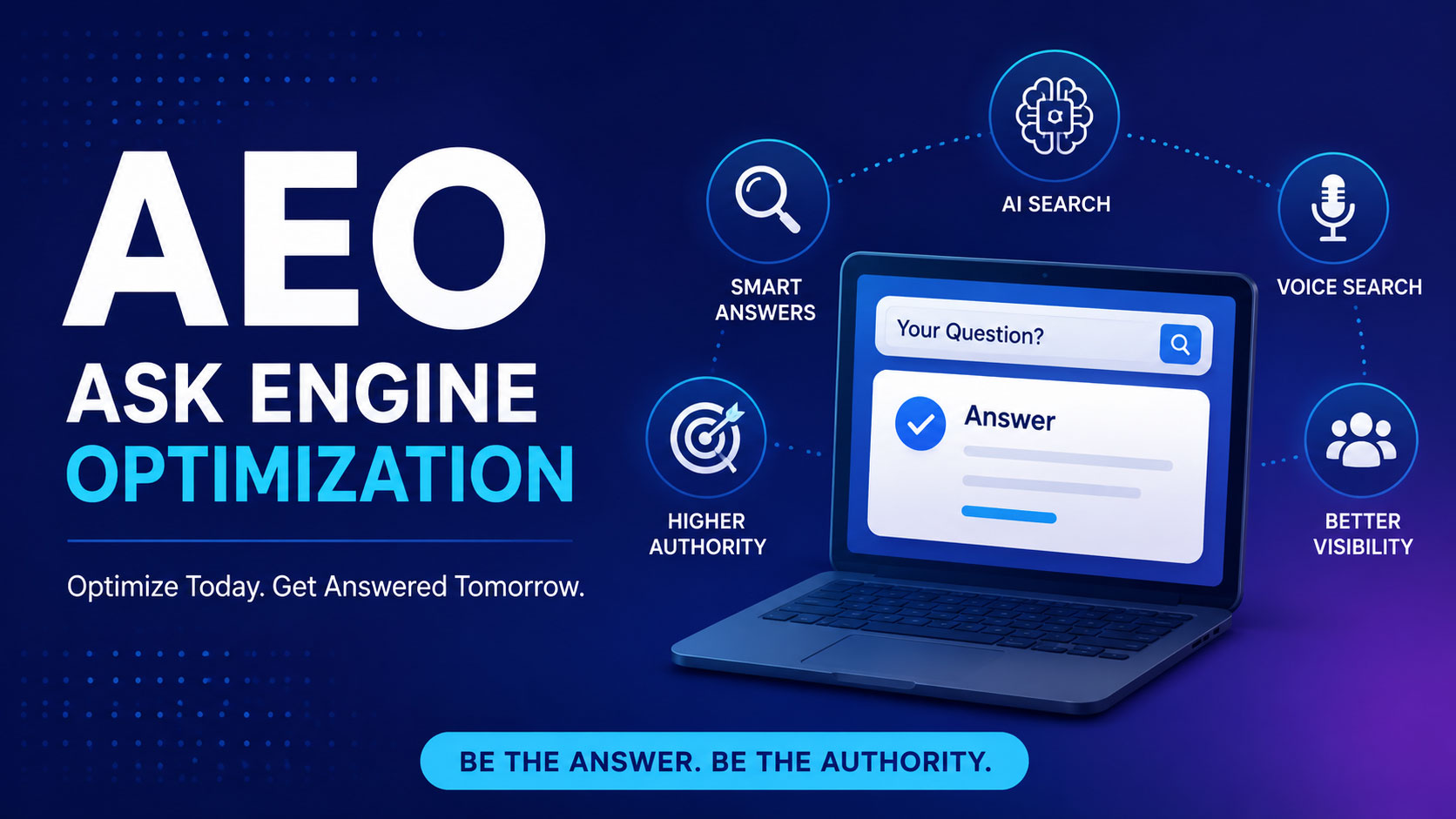
Ask Engine Optimization (AEO) is the process of optimizing content, website structure, entities, and structured data so that answer engines, AI assistants, voice search systems, and generative AI platforms can understand, trust, reference, and cite a business when responding to user questions. As search evolves beyond traditional keyword-based search engines, AEO helps organizations become visible in AI-generated answers, conversational interfaces, and answer-driven search experiences.
In simple terms, traditional SEO helps a website rank in search results, while Ask Engine Optimization helps a website become the source of answers delivered directly by AI systems. As technologies such as ChatGPT, Google AI Overviews, Gemini, Perplexity AI, Microsoft Copilot, and voice assistants continue changing how people discover information, AEO has emerged as one of the most important digital visibility strategies for modern businesses.
Key Takeaways
- AEO focuses on answer visibility rather than only search rankings.
- Answer engines prioritize trusted, structured, and authoritative information.
- Schema markup helps AI systems understand website content.
- Entity optimization strengthens knowledge graph visibility.
- AEO complements SEO rather than replacing it.
- Question-focused content often performs better in answer-driven environments.
- AI citations can significantly increase brand authority and visibility.
- Businesses adopting AEO early may gain a competitive advantage in AI search ecosystems.
What is Ask Engine Optimization (AEO)?
Ask Engine Optimization is a specialized branch of search optimization focused on making information discoverable, understandable, and reusable by answer engines. Unlike traditional search engines that display lists of webpages, answer engines attempt to provide direct answers to user questions. These systems rely heavily on content quality, semantic relevance, entity relationships, structured data, and trust signals.
The goal of AEO is not simply to increase rankings. Instead, it is to position a brand, website, or organization as a trusted source of information that AI systems can confidently reference when generating responses.
For example, if a user asks:
- "What is Ask Engine Optimization?"
- "How much does AEO cost?"
- "Which companies provide AEO services?"
- "What is the difference between SEO and AEO?"
An answer engine may generate a direct response without requiring the user to click a website. Organizations implementing AEO strategies increase their chances of being referenced within those generated answers.
Why is Ask Engine Optimization Becoming Important?
Search behavior has evolved significantly over the past decade. Early search engines primarily relied on keyword matching. Modern search systems increasingly use artificial intelligence, natural language processing, machine learning, and knowledge graphs to understand user intent.
Users are no longer typing short phrases such as:
- "best seo agency"
- "aeo service"
- "voice search optimization"
Instead, they ask complete questions:
- "What is the best strategy for AI search visibility?"
- "How can my business appear in ChatGPT answers?"
- "What services improve AI citations?"
Answer engines are designed to satisfy these queries directly. As a result, websites must optimize not only for search engines but also for systems that generate answers.
This transition represents one of the most significant shifts in digital marketing since the introduction of modern search engines.
The Evolution from Search Engines to Answer Engines
Understanding AEO requires understanding how search has evolved.
| Era | Primary Technology | User Behavior | Optimization Focus |
|---|---|---|---|
| Early Search Era | Keyword Matching | Short Searches | Basic SEO |
| Semantic Search Era | Intent Recognition | Longer Queries | Content Relevance |
| Mobile Search Era | Context Awareness | Voice Search | User Experience |
| AI Search Era | Generative AI | Conversational Questions | AEO + GEO + SEO |
The rise of large language models and conversational AI systems has accelerated the transition from information retrieval toward answer generation. Businesses that adapt to this shift may achieve stronger visibility across emerging search ecosystems.
Definitions of Important AEO Terms
Answer Engine
An answer engine is a system that provides direct answers to user questions instead of simply displaying a list of links. Examples include AI assistants, voice assistants, and generative search experiences.
Entity
An entity is a uniquely identifiable person, organization, place, product, concept, or event that can be recognized and connected within knowledge graphs.
Knowledge Graph
A knowledge graph is a structured network of entities and relationships used by search engines and AI systems to understand context.
Structured Data
Structured data is machine-readable information added to webpages using schema markup to help systems understand content meaning.
AI Citation
An AI citation occurs when an artificial intelligence system references information from a source while generating a response.
Voice Search
Voice search refers to spoken queries performed through digital assistants and smart devices.
Natural Language Processing (NLP)
Natural Language Processing is a branch of artificial intelligence that enables machines to understand human language.
How Answer Engines Work
Answer engines use multiple technologies simultaneously to generate responses. These technologies often include:
- Natural Language Processing (NLP)
- Machine Learning Models
- Large Language Models (LLMs)
- Knowledge Graphs
- Entity Recognition Systems
- Semantic Search Algorithms
- Information Retrieval Frameworks
When a user asks a question, the system attempts to identify intent, gather relevant information, evaluate trustworthiness, and generate a useful answer. Content that clearly explains concepts and provides reliable context is more likely to influence generated responses.
This is why AEO places strong emphasis on clarity, factual accuracy, semantic relationships, and structured organization.
Who Needs Ask Engine Optimization Services?
AEO can benefit organizations across nearly every industry. Any business that relies on online visibility, expertise, authority, or information discovery can gain value from answer-engine optimization.
- Software Companies
- Technology Firms
- Healthcare Organizations
- Educational Institutions
- Professional Service Providers
- Law Firms
- Financial Companies
- Manufacturing Businesses
- E-commerce Brands
- Digital Agencies
- SaaS Companies
- B2B Organizations
The more questions customers ask about an industry, product, service, or expertise area, the greater the opportunity for AEO-driven visibility.
How Ask Engine Optimization (AEO) Works
Ask Engine Optimization works by helping answer engines understand the meaning, authority, trustworthiness, and context of information published on a website. Traditional search engine optimization primarily focuses on ranking webpages for keywords. AEO expands that approach by ensuring content can be interpreted, summarized, cited, and referenced by AI systems that generate answers.
Modern answer engines use multiple signals when deciding which sources should influence a response. These signals often include topical authority, entity relationships, content quality, factual consistency, structured data implementation, author credibility, user engagement indicators, and overall website trustworthiness.
When a user asks a question, an answer engine typically follows a process similar to the following:
- Interpret the user's intent.
- Identify relevant entities and concepts.
- Retrieve authoritative information.
- Evaluate trust and relevance signals.
- Generate a response using available knowledge.
- Cite or reference supporting sources when appropriate.
AEO aims to improve visibility at every stage of this process by making information easier to understand, verify, and connect to broader knowledge networks.
AEO vs SEO vs GEO: Understanding the Differences
Many businesses assume AEO replaces SEO. In reality, the strongest digital visibility strategies combine Search Engine Optimization (SEO), Ask Engine Optimization (AEO), and Generative Engine Optimization (GEO).
| Factor | SEO | AEO | GEO |
|---|---|---|---|
| Primary Goal | Rank Higher in Search Results | Become the Answer | Increase AI Citations |
| Main Focus | Keywords | Questions | Generative AI Visibility |
| Content Structure | Search-Friendly | Answer-Friendly | AI-Friendly |
| User Journey | Click Through Website | Receive Direct Answer | Discover Through AI |
| Schema Importance | Helpful | Important | Critical |
| Entity Optimization | Moderate | High | Very High |
| Knowledge Graph Usage | Helpful | Important | Essential |
| AI Citation Focus | Limited | High | Very High |
SEO remains the foundation of discoverability. AEO builds on that foundation by optimizing content for direct answers. GEO extends visibility into AI-generated experiences and emerging search ecosystems.
Entity Optimization: The Foundation of Modern AEO
Entity optimization is one of the most important components of Ask Engine Optimization. Search engines and AI systems increasingly understand information through entities rather than keywords alone.
An entity can represent:
- A company
- A person
- A product
- A service
- A location
- An event
- A concept
For example, "RiAcube Software Hub" is an entity. "Ask Engine Optimization" is another entity. When AI systems understand the relationship between these entities, they gain confidence about expertise and relevance.
Entity optimization often includes:
- Consistent brand mentions
- Structured business information
- Knowledge graph development
- Schema markup implementation
- Topical authority creation
- Semantic relationship mapping
Strong entity signals help answer engines connect a business with relevant topics and services.
Knowledge Graph Optimization
Knowledge graphs help machines understand how entities relate to one another. Search engines and AI systems use knowledge graphs to organize information and identify relationships.
For example, an optimized knowledge graph may establish relationships such as:
- RiAcube Software Hub → provides → AEO Services
- AEO Services → support → AI Search Visibility
- AI Search Visibility → improves → AI Citations
- AI Citations → strengthen → Brand Authority
These relationships create contextual understanding. The more clearly a website communicates relationships among entities, the easier it becomes for answer engines to interpret expertise and relevance.
Schema Markup and Structured Data for AEO
Schema markup is one of the most powerful tools available for Ask Engine Optimization. It provides machine-readable context that helps search engines and AI systems understand webpage content.
Without schema markup, machines must infer meaning from content. With schema markup, important information is explicitly communicated.
Common schema types used in AEO include:
- Organization Schema
- Service Schema
- FAQ Schema
- Article Schema
- WebSite Schema
- Breadcrumb Schema
- Review Schema
- Person Schema
- LocalBusiness Schema
Schema markup improves machine comprehension and often contributes to enhanced search features, rich results, and improved contextual understanding.
Why FAQ Schema Matters
Frequently Asked Questions naturally align with answer engine behavior because they mirror how users interact with AI systems. FAQ schema helps machines identify questions and corresponding answers more efficiently.
Why Service Schema Matters
Service schema clearly communicates what services a business provides, making it easier for answer engines to connect expertise with user queries.
Topical Authority and Semantic Coverage
One of the strongest trust signals in modern search is topical authority. Rather than publishing isolated content pieces, successful AEO strategies develop comprehensive topic ecosystems.
For example, an AEO-focused website might publish content covering:
- What is AEO?
- AEO vs SEO
- AEO vs GEO
- AI Search Visibility
- Knowledge Graph Optimization
- Schema Markup
- AI Citation Strategies
- Voice Search Optimization
- Entity SEO
When a website covers an entire subject area comprehensively, answer engines gain stronger confidence in the site's expertise.
AI Citation Optimization
AI citation optimization refers to increasing the likelihood that content will be referenced, summarized, or cited by AI systems.
Although citation methodologies vary across platforms, several common characteristics frequently appear in AI-cited content:
- Clear explanations
- Direct answers
- Authoritative information
- Consistent terminology
- Entity-rich content
- Structured organization
- Reliable references
- Comprehensive coverage
Businesses seeking visibility within AI-generated answers should prioritize informational value over promotional language.
Voice Search and AEO
Voice search represents one of the earliest forms of answer-engine interaction. Digital assistants typically provide a single answer rather than a list of search results.
This behavior closely resembles modern AI answer engines. As a result, many voice-search optimization practices align naturally with AEO principles.
Effective voice-search content often includes:
- Natural language phrasing
- Question-based headings
- Concise answers
- Local relevance
- Structured data
- Authority signals
Original Research: Observed Characteristics of AI-Citable Content
Analysis of answer-focused content across multiple industries reveals recurring patterns among pages that demonstrate strong AI visibility potential.
| Content Characteristic | Observed Impact on AI Visibility |
|---|---|
| Clear Definitions | Improves machine understanding |
| Question-Based Structure | Aligns with conversational search |
| Entity Optimization | Strengthens contextual relevance |
| Schema Markup | Enhances machine readability |
| Topical Depth | Builds authority signals |
| Source References | Supports trustworthiness |
| Fact Boxes | Improves answer extraction |
| FAQ Sections | Supports direct-answer generation |
These observations suggest that answer engines favor information architecture that combines clarity, structure, authority, and semantic completeness.
Related Entities Supporting AEO Knowledge Graphs
To strengthen contextual understanding, AEO content should naturally reference closely related entities and concepts.
- Artificial Intelligence
- Machine Learning
- Large Language Models (LLMs)
- Natural Language Processing (NLP)
- Semantic Search
- Knowledge Graphs
- Schema.org
- Google Search Central
- OpenAI Documentation
- Voice Search
- Information Retrieval
- Generative AI
- Entity SEO
- Structured Data
- Digital Knowledge Management
These related entities help answer engines build stronger contextual relationships around the topic of Ask Engine Optimization.
Frequently Asked Questions (FAQs) About Ask Engine Optimization (AEO)
What is Ask Engine Optimization (AEO)?
Ask Engine Optimization (AEO) is the process of optimizing content, entities, structured data, and website architecture so answer engines, AI assistants, voice search systems, and generative AI platforms can understand, trust, and use information when answering user questions.
How is AEO different from SEO?
SEO primarily focuses on improving visibility in traditional search engine results pages, while AEO focuses on becoming a trusted source for direct answers generated by AI systems and answer engines.
What is the difference between AEO and GEO?
AEO focuses on optimizing content for answer engines and direct responses. GEO (Generative Engine Optimization) focuses on increasing visibility and citations within generative AI systems such as ChatGPT, Gemini, Copilot, and Perplexity.
Why is AEO important for businesses?
As more users rely on AI-powered search experiences, businesses need to ensure their information can be discovered, understood, and cited by answer engines. AEO helps improve visibility, authority, and brand recognition in AI-driven search environments.
Can AEO improve AI citations?
Yes. AEO improves the likelihood that content will be referenced, cited, summarized, or used by AI systems by strengthening authority signals, structured data, entity relationships, and content quality.
What types of businesses benefit from AEO?
Technology companies, SaaS providers, healthcare organizations, educational institutions, law firms, financial services companies, eCommerce brands, manufacturers, and professional service providers can all benefit from AEO strategies.
Does schema markup help with AEO?
Yes. Schema markup provides machine-readable information that helps answer engines understand content context, entities, services, FAQs, reviews, and organizational information.
What schema types are most important for AEO?
Common schema types include Organization Schema, Service Schema, FAQ Schema, Article Schema, WebSite Schema, BreadcrumbList Schema, Review Schema, and Person Schema.
Does AEO replace SEO?
No. AEO complements SEO. Businesses should combine SEO, AEO, and GEO strategies to maximize visibility across traditional search engines and AI-powered search environments.
How long does it take to see results from AEO?
Results vary depending on website authority, content quality, competition, and implementation scope. AEO should be viewed as a long-term authority-building strategy rather than a short-term ranking tactic.
Can small businesses benefit from AEO?
Yes. Small businesses can compete effectively by publishing authoritative content, implementing structured data, optimizing entities, and answering customer questions clearly.
What services are typically included in an AEO campaign?
AEO services commonly include entity optimization, knowledge graph development, schema implementation, FAQ creation, AI citation optimization, content restructuring, topical authority building, and voice search optimization.
Explore More AI Search Optimization Strategies
Learn how modern search technologies are evolving and explore proven strategies to improve rankings, AI citations, answer engine visibility, and online authority.
 Have a project idea? Let’s discuss.